
Submission to the Inquiry into the Thriving Kids initiative
10/10/2025
Thriving Kids is a national opportunity to realise equitable, inclusive developmental systems for all Australian children and families.
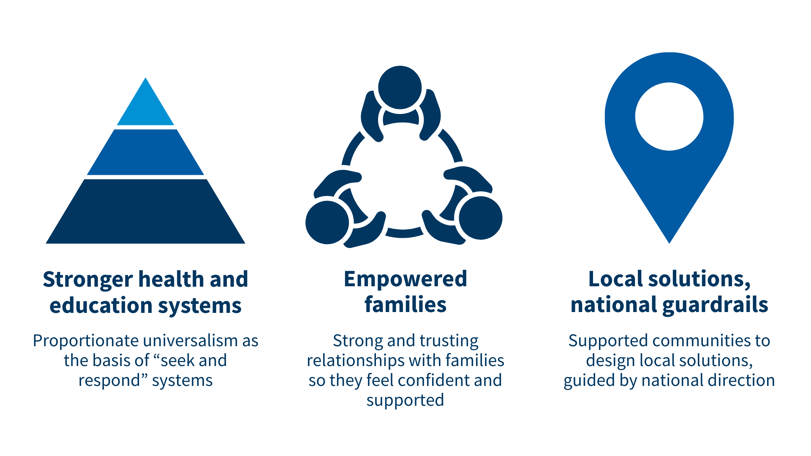
With 12.5% of children starting school developmentally vulnerable in two or more key developmental domains, and rates of developmental vulnerability existing along a social gradient, bold, system-wide reform must underpin Thriving Kids. That’s why we’ve proposed three core elements to guide the design and delivery of Thriving Kids, as part of our submission to the Inquiry into the Thriving Kids initiative:
 Watch Sharon Goldfeld explain each of the core elements below in an excerpt from our October 2025 webinar.
- Uplift of mainstream health and education systems
Thriving Kids must strengthen the universal platforms children and families already engage with every day - maternal and child health services, primary health care, early childhood education and care (ECEC), and schools. These systems need to be equipped to identify and respond to developmental needs early. We recommend a shift from “seek and refer” to “seek and respond” models across health and education systems, using proportionate universalism to ensure services can scale to meet varying levels of need. - Empowered families
Parents and carers play a vital role in identifying and supporting their child’s development. Thriving Kids should ensure parents have universal, inclusive, and responsive supports to understand child development, strengthen parenting skills, navigate services, and be provided opportunities to build social connections. Providing multiple offerings such as evidence-based advice and information, digital navigation supports, playgroups, structured family programs, and peer support networks, ensures parents can access a range of supports that meet their needs. The National Best Practice Framework for Early Childhood Intervention provides guidance to support understanding about what best practice in early childhood intervention looks like and can be used by parents, practitioners, services and policy makers to guide decision making. - Local solutions with national guardrails
The local contexts in which children and families live, learn and grow matter to children’s outcomes. Thriving Kids can provide a national framework with clear guardrails to ensure local solutions meet the needs of children and families, whilst maintaining consistency, quality, and accountability. National mechanisms such as planning, commissioning, implementation and evaluation and monitoring will enable local innovation while maintaining national consistency. Australia’s network of over 470 Child and Family Hubs is a powerful delivery mechanism- offering integrated, tiered services that can respond to local needs while maintaining a shared goal of delivering high-quality care for children and families.
Any system that aspires for all children to thrive must be built with equity design principles from the start with co-design and co-development at its core.
We propose five principles to guide this reform:
- equity and inclusiveness
- identifying social determinants and adversity
- prioritising prevention and early intervention
- child and family-centred design
- data-driven decision-making.
Read our full submission including responses addressing the each of the Inquiry’s Terms of Reference.
