
Closing the equity gap within a generation: reality or fantasy?
15/01/2026
This is an excerpt from the Global Access Partners Intergenerational Summit Report.
Prof Sharon Goldfeld AM reflected on the tension between optimism and pessimism in advancing equitable childhood development but chose an optimistic framing for her address. Drawing on Gabriela Mistral’s poem His Name is Today, she underscored the moral urgency of acting now to support children’s development rather than deferring responsibility.
The Australian Early Development Census (AEDC) is the world’s only nationwide triennial assessment of all children entering school. Its findings show a growing proportion of children vulnerable in two or more developmental domains, significantly reducing their likelihood of thriving in school and life. In 2024, 12.5% of Australian children were developmentally vulnerable in multiple domains, with rates rising to 20.3% in the poorest areas compared with 7.6% in wealthier communities. Schools cannot bridge this divide alone, and Prof Goldfeld argued that the $22 billion spent annually on youth justice and child protection could be more effectively channelled into earlier interventions.
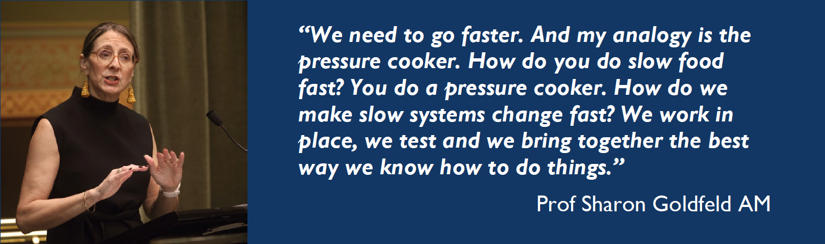
Life expectancy has plateaued for the first time in Australia, reflecting rising burdens of chronic disease whose origins lie in early life. Preventative health measures should therefore prioritise children and younger adults. While acknowledging there are no simple solutions, Prof Goldfeld urged adoption of practical, evidence-based steps supported by data, political will and a genuine sense of urgency, drawing lessons from earlier achievements such as equalising child immunisation rates nationwide. She described her preferred policy approach as akin to a pressure cooker – 'slow food fast’– calling for place-based implementation of what already works.
Prof Goldfeld welcomed the current policy environment, with significant national and state investments such as the Investment Dialogue for Australia’s Children, Stronger Places, Stronger Children and the Building Early Education Fund. GenV, now involving more than 124,000 children and parents, provides both a research platform and a community partnership capable of informing scalable solutions.
Closing her remarks, she cited Prof Donald Berwick’s challenge to leaders to make ‘the currently unthinkable thinkable’, urging policymakers to move beyond inherited systems and mental boundaries. Only by embracing new possibilities can Australia build a society in which every child has a strong and fair start in life.
