
Overview
What is Best Start?
Best Start aims to give every child the best start in life. The initiative works towards this by improving children’s learning and development and encouraging agencies and services to work together to address challenges faced by families and communities. Best Start focuses on supporting children and families experiencing vulnerability, and increasing the participation of all First Nations children in universal early childhood services.
Best Start commenced in 2002 and is now based in 29 sites across Victoria – our Best Start Network. The network includes:
- 5 corporations owned by First Peoples
- 21 local government agencies
- 3 community health services.
These sites lead reform at local levels by enabling local services to work together to deliver on Best Start outcomes.
Quality improvement
Best Start uses a quality improvement approach to implementation, with rapid cycles to develop, test and measure small practice changes. As changes are shown to be successful, they’re applied throughout a site.
The Centre for Community Child Health supports Best Start sites through training and coaching facilitators and Early Childhood Performance and Planning Advisors in this improvement approach.
We use evidence and data to more effectively identify and address barriers to participation in services, and to measure the results of the initiative.
We’ve co-designed an online portal with community data dashboards, customisable for each site, which helps facilitators and advisors to understand progress in their community.
The Best Start Network has identified and co-designed six domains of effective quality improvement. This includes:
- Shifting your mindset: Being curious and open to change and learning.
- Developing technical knowledge and skills: Using data and quality improvement tools to monitor and support progress.
- Creating buy-in: Engaging stakeholders to become active participants by enabling them to see ‘what’s in it for them’.
- Deepening relationships: Developing and sustaining genuine engagement through communication, acknowledgement and authenticity.
- Building the capacity of others: Supporting emerging quality improvement practitioners to build their capacity and confidence to do and lead the work.
- Practicing professional self-care: Being watchful of morale and workload, and using strategies such as reflection to maintain wellbeing.
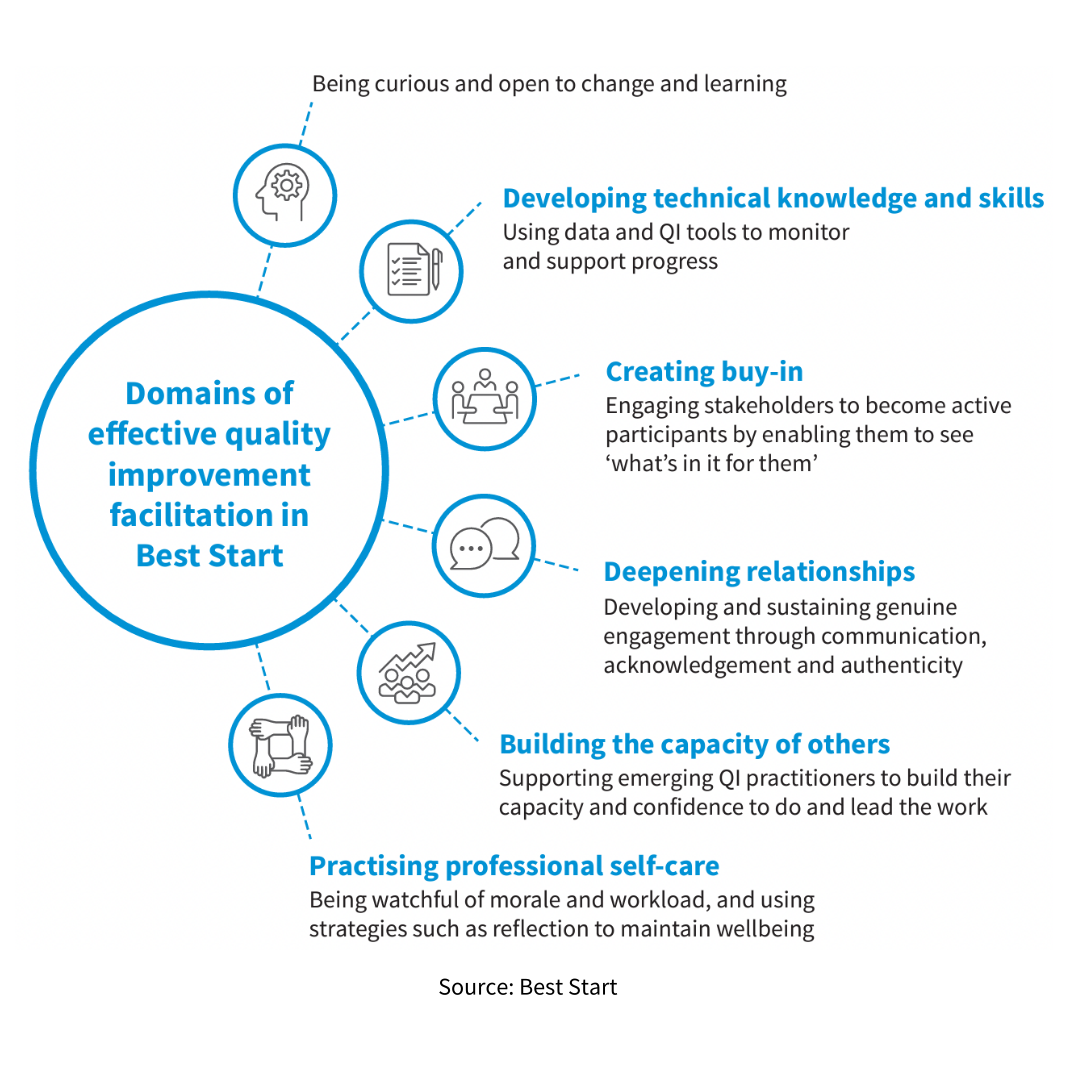
Figure 1: Domains of effective quality improvement facilitation in Best Start.
Our impacts and achievements
Over the last 20 years, Best Start has evolved in response to community need and policy changes. Since 2016, the Centre for Community Child Health has supported Best Start through sharing evidence-based solutions to overcoming barriers to kindergarten participation.
- Best Start understands that improving kindergarten participation requires the provision of support and care to families from a child’s birth.
- Best Start works with partners on the ground to ensure children and their families navigate maternal and child health services, supported playgroup, child protection, child health services, early start kindergarten, and 3- and 4-year-old kindergarten in a seamless, supportive and culturally safe way.
- By using quality improvement, Best Start helps local partners to identify, test and scale small changes to their practice, ensuring localised and bespoke solutions to increase kindergarten participation.
- Best Start has published a series of promising papers to document and share best practice across the network.
- The development of the Best Start Improvement Approach Guide and webinars ensures continuity in technical practice across the network.
Our approach
Participation in high quality kindergarten benefits children’s health and development. Though beneficial for all children, the positive effects of kindergarten participation are especially important for children from disadvantaged and vulnerable backgrounds.
Every year, about 18.5% of children from Australia’s lowest socioeconomic quintile enter school developmentally vulnerable on two or more domains for the Australian Early Development Census. This is almost three times the rate for children in the highest socioeconomic quintile (6.5%). In recent years, the gap between the poorest and wealthiest communities has increased.
Best Start partnerships use an improvement science approach to increase participation in universal early years services. This involves exploring the root causes of low participation, identifying possible solutions and the testing these through multiple Plan-Do-Study-Act cycles.
The Centre for Community Child Health is working to ensure that the Best Start Network is:
- supported in quality improvement approaches
- challenged to use and explore relational practice – the meaningful and genuine interaction between families and service providers that promotes trust
- encouraged to learn from each other to identify solutions that overcome barriers to kindergarten participation in Victoria.
Partners and funders
Best Start is a partnership between the Centre for Community Child Health at the Murdoch Children's Research Institute and the Victorian Department of Education.
Resources
Upcoming training and events
- [Toolkit and Guide] Best Start Improvement Approach Guide.
The Best Start Improvement Approach Guide provides instructions for implementing the Best Start improvement approach. - [Snapshot series] Promising Practice in Best Start series.
The Promising Practice in Best Start series captures what is being learnt through Best Start about how to use quality improvement to increase participation in early years services.- Paper 1. How to facilitate quality improvement
- Paper 2. How to increase participation in early year services
- Paper 3. Ideas for improving kindergarten participation
- [Video series] Best Start Orientation videos.
This video series provides an orientation for staff new to the Best Start facilitator role and those new to supporting Best Start facilitators, about the improvement approach that underpins implementation of the Best Start initiative.
- [Webinar] Learning and changing: Using quality improvement to create more equitable services, 25 March 2021.
This webinar was part of the Thriving Children, Thriving Communities series by the Centre for Community Child Health hosted by Professor Sharon Goldfeld exploring how quality improvement is being used to build understanding of communities, share learnings and create partnerships for change. - [Webinar] Moving from testing change ideas to implementation and spreading practice change, 28 March 2018.
Dr Inkleas hosted a webinar in March 2018 exploring ‘moving from testing change ideas to implementation and spreading practice change’. - [Webinar] Measurement and change to improve the wellbeing of children and families, 7 December 2016.
Associate Professor Moira Inkelas explores ‘measuring improvement’ based on Dr Inkelas' experience in using quality improvement methodologies on changing systems in the USA. - [Blog] Learning and changing with quality improvement blog series.
This blog series shares insights from the Centre's work with early childhood services in system redesign in Australia as well as practical tips from international partners driving quality improvement overseas. - [Video] Best Start 2024 Forum.
In March 2024, the Centre and the Victorian Aboriginal Community Services Association Ltd (VACSAL) brought together key personnel to address barriers to kindergarten participation.
Contact us
Contact the Best Start team at [email protected]