
Overview
For kids, going to the doctor can be a daunting experience. Healthcare is viewed by clinicians, parents and even children themselves as something done to children, but our research shows children are ready and able to take an active role in prioritising what matters most to them in the doctor’s office.
What is the P-PROM ROCK program?
The P-PROM ROCK Program is Australia's first co-designed, trialled and evaluated program for including children's voices in outpatient clinical care. Developed in collaboration with the University of Melbourne, Murdoch Children’s Research Institute and The Royal Children’s Hospital, the program asks children how different aspects of their physical and emotional health are going and ensures their answers are heard and acted upon in appointments.
Too often, healthcare is something done to children rather than with them. Parents and clinicians speak on behalf of children, assuming they know what matters most. But research shows that children's health priorities often differ from what adults assume. Children as young as seven can reliably report their own health, yet structured ways to capture and act on their perspectives in clinical care are rarely available. Without these, children's voices risk being overlooked in the very appointments designed to support them.
The P-PROM ROCK Program addresses this by giving children a structured, supported way to share how their health is going before their appointment — and ensuring their answers shape what happens in the room. Using a short, child-friendly health questionnaire (formally known as the EQ-5D-Y-5L), children and families can identify which aspects of their health they most want to discuss with their clinician. Clinicians are equipped with training and resources to locate, discuss and respond to children's answers meaningfully. The program was co-designed through workshops and interviews with children, parents and clinicians, ensuring it works for everyone involved.
This is the first program of its kind in Australia to be co-designed with children, parents and clinicians, and then rigorously evaluated through a randomised controlled trial. Children and families were not just participants — they were co-designers and co-authors of the research. The program produced freely available resources for real-world use, and peer-reviewed evidence on its feasibility, acceptability and impact has been published in leading international journals including JAMA Network Open. This work demonstrates that when children are genuinely included in designing their care, healthcare becomes more meaningful, more useful and more responsive to what matters most to them.
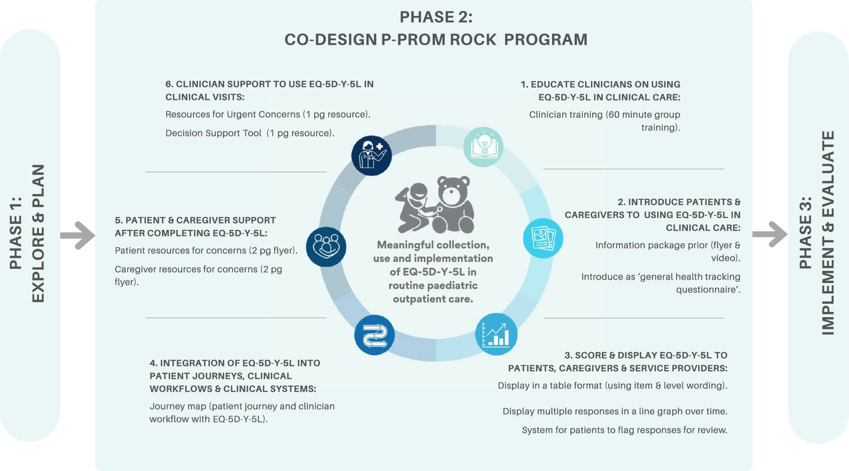 Figure 1. Overview of the program
Our impact and achievements
- Co-designed with children and families: Children, parents and clinicians co-designed the P-PROM ROCK Program together — with children and families recognised as co-authors — providing the first blueprint for embedding children's health questionnaires in clinical care
- Trialled at The Royal Children's Hospital: 87 children aged 4 to 17 years and their caregivers trialled the program across four outpatient clinics — with 93% completing the health questionnaire, demonstrating feasibility of the P-PROM ROCK Program across a range of ages and health conditions
- Freely available resources: A suite of co-designed, freely available tools and resources — including clinician training, a patient-controlled flagging system, resources for children and their parents, and a clinician decision support tool — ready for health services to use
- Scaling for all Australian children: We are actively working to scale the P-PROM ROCK Program across
- Australian paediatric care — so every child has a voice in their healthcare
- Going global: Health services in New Zealand and Argentina are already adapting the P-PROM ROCK Program — demonstrating that children's voices in healthcare is a global priority
Our approach
The P-PROM ROCK Program is the first co-designed, trialled and evaluated program in Australia for including children's voices in outpatient clinical care. Rather than simply asking children to complete a health questionnaire, the program wraps support around the entire process — equipping families to understand and complete the questionnaire, empowering children to identify which aspects of their health they most want to discuss, and equipping clinicians with the training and resources to meaningfully respond. Critically, children, parents and clinicians were not just consulted — they were co-designers and co-authors, shaping every aspect of the program from the ground up.
We wanted to understand whether asking children how their health is going in outpatient appointments could meaningfully improve their care. Specifically, we wanted to know whether a generic children's health questionnaire — the EQ-5D-Y-5L — could be feasibly and acceptably embedded in routine outpatient care at a major paediatric hospital. We also wanted to understand what supports and resources were needed to make this work in practice, and whether children, families and clinicians would find it useful and meaningful.
Our research shows it is both feasible and acceptable to ask children about their health in outpatient appointments. In Australia's first randomised controlled trial of its kind, 93% of children completed the health questionnaire, and the majority of caregivers (89%) and clinicians (64%) reported the program was acceptable. Clinicians reported the program improved communication with children and families, and children told us the questionnaire helped their clinicians 'understand our situations better'. For more detail, access our published research:
- Initial qualitative study (pre-codesign)
- Co-design study
- Randomised controlled trial
- Qualitative insights following trial
Having demonstrated that the P-PROM ROCK Program is feasible, acceptable and ready for real-world use, our focus is now on scaling. We are actively working to embed the program across Australian paediatric outpatient care and are in conversation with health services in New Zealand and Argentina who are adapting the program for their local contexts. Investment is needed to make this vision a reality — ensuring every Australian child has a voice in their healthcare and their health priorities are heard and acted upon in appointments.
Our team
Dr Renee Jones, Lead Investigator, Centre for Community Child Health
Prof Kim Dalziel, Senior Advisor, Centre for Community Child Health
Prof Harriet Hiscock, Senior Advisor, Centre for Community Child Health
Prof Valerie Sung, Advisor and co-designer, Centre for Community Child Health
Dr Karen McLean, Advisor and co-designer, Centre for Community Child Health
A/Prof Gehan Roberts, Advisor, Centre for Community Child Health
Partners and funders
This research was funded by a EuroQol Research Foundation grant (330-PhD). Furthermore, Dr Jones’ PhD was supported by a Research Training Program Scholarship provided by the Australian Commonwealth Government and the University of Melbourne.
The P-PROM ROCK Program is a collaboration between the University of Melbourne, Murdoch Children's Research Institute and The Royal Children's Hospital. Alongside the many children, families and clinicians who contributed to the co-design and trial of the P-PROM ROCK Program, the program was co-designed and published by the following named contributors: Renee Jones, Kim Dalziel, Harriet Hiscock, Nancy Devlin, Karen McLean, Diana Truong, Andrew Dao, Kathe Holmes, Kath Feely, Jessica Taranto, Abby Palmer, Tanya Wolfe, Penny Richards Fowler, Kirsten Pini, Max Pini, Einat Martonovich-Lantsberg, Joanna Lawrence, Misel Trajanovska, Adele Berry, Valerie Sung and Sebastian King.
Resources
The following P-PROM ROCK materials are freely available in the supplementary file of the corresponding co-design manuscript.
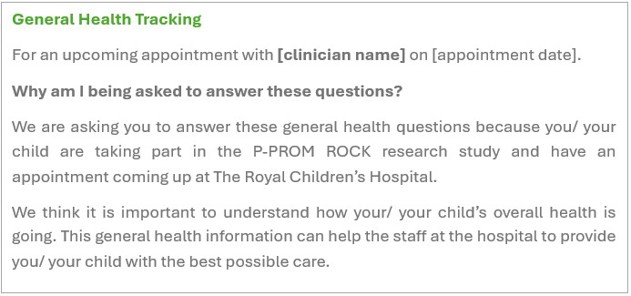
- P-PROM ROCK patient introduction (supplementary Figure 2). Explains to children and families what the P-PROM is, why they are being asked to complete it and what will happen with their answers — in language they can understand (i.e., using ‘general health questionnaire’ instead of P-PROM).
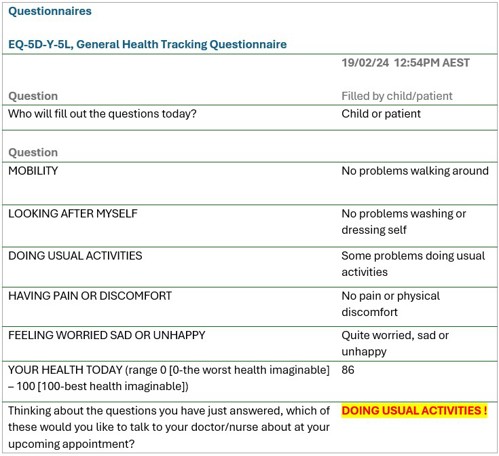
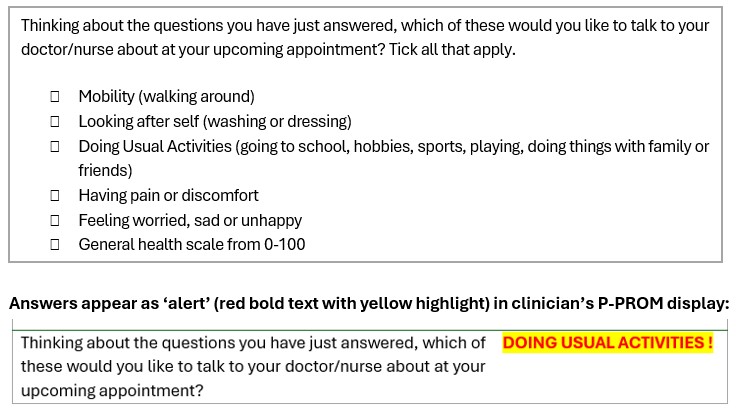
- P-PROM ROCK flagging system (supplementary Figure 3 and 5). Allows children and families to identify which aspects of their P-PROM (‘general health questionnaire’) responses they most want to discuss with their clinician — their selections appear as a highlighted alert in the clinician's display, ensuring their priorities are not missed.
- P-PROM ROCK display (supplementary Figure 3). Displays children's P-PROM (‘general health questionnaire’) answers in a simple table format for families and clinicians to review together — deliberately avoiding external thresholds or value judgements, putting interpretation in the hands of the child and family.
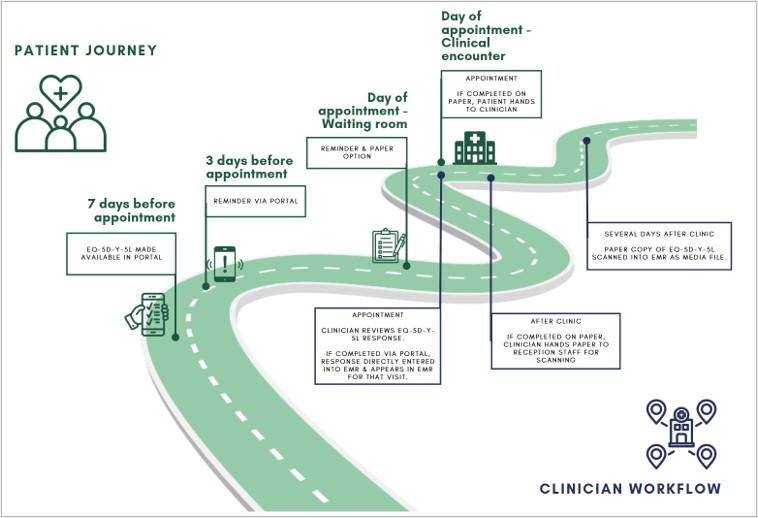
- P-PROM ROCK journey map (supplementary Figure 6). Outlines the full journey of the P-PROM (‘general health questionnaire’) — how and when children and families complete it, and how, when and by which clinician their answers are reviewed and acted upon.
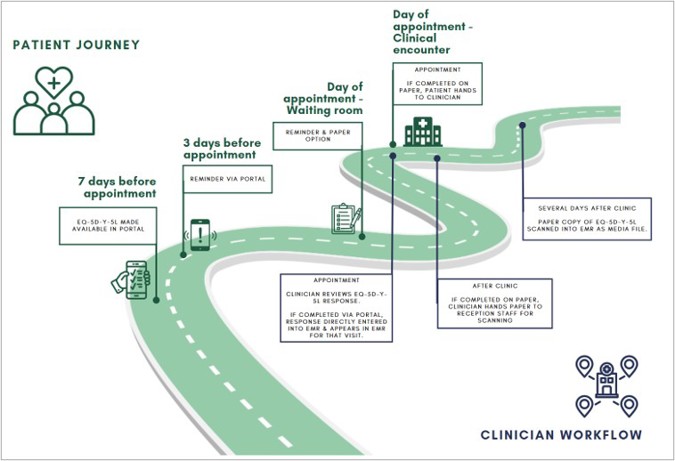
- P-PROM ROCK family resources (supplementary figure 7). A two-page guide helping children and families understand and act on their P-PROM (‘general health questionnaire’) responses and access support for areas of concern. Download the resources.
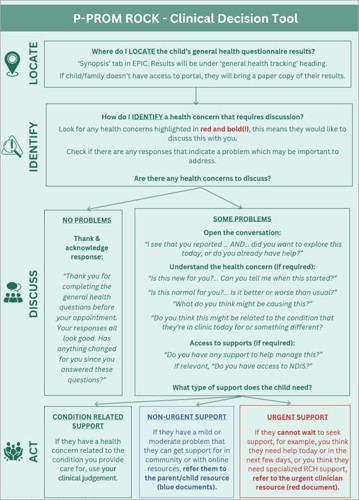
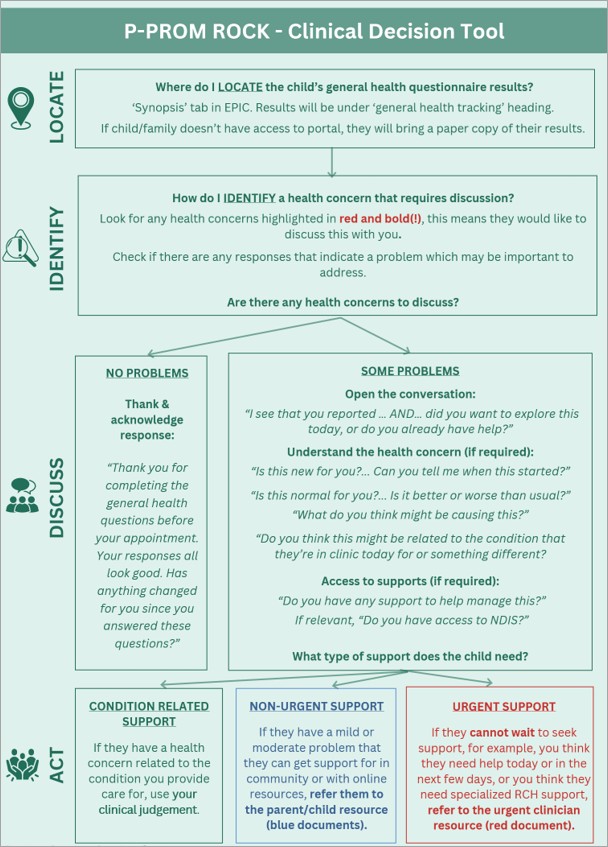
- P-PROM ROCK clinician decision support tool (supplementary figure 8). A one-page guide helping clinicians locate, discuss and respond to children's P-PROM (‘general health questionnaire’) answers in appointments.
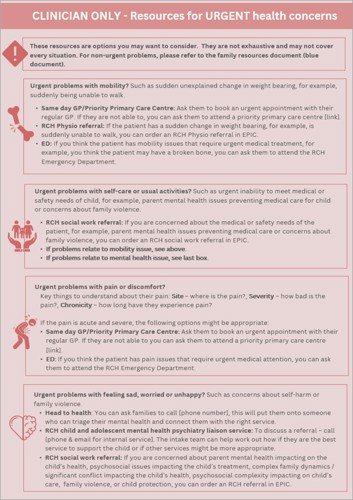
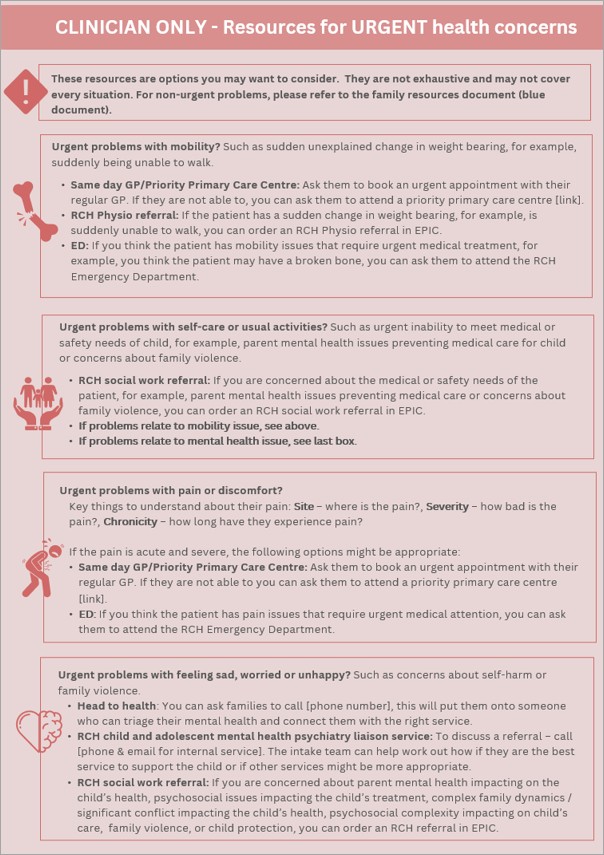
- P-PROM ROCK clinician resource for urgent P-PROM concerns (supplementary figure 9). A one-page guide for clinicians outlining how to respond when a child's P-PROM (‘general health questionnaire’) reveals an urgent concern requiring same-day action.
Affiliated papers
Contact us
Interested in adapting of using the P-PROM ROCK Program in your health service?
Collaborate with us by contacting Renee Jones ([email protected] or [email protected])