
Égalité is not equity: How can we do ‘different’ rather than ‘more’
Notes from Paris on child equity series:
-
- The one with the giant flower: France as a case study on early child development systems in Europe
- Égalité is not equity: How can we do ‘different’ rather than ‘more'
Prof Sharon Goldfeld AM
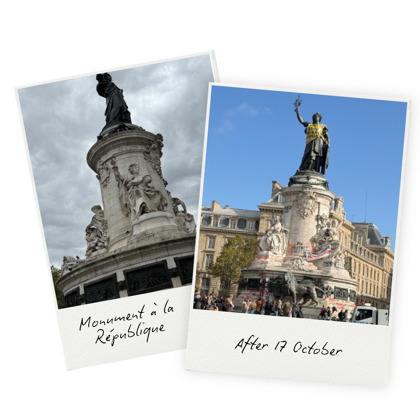
I have been in Paris for a month now, and it seems almost impossible to write this blog without reflecting on the protests happening across France. Part of the great privilege of being in another country is taking the time to talk to people and learn about their cultural approaches not only to food but also to life.
Here in France, the idea of protest is part of a set of beliefs that is embedded in the way the French go about their lives. It can be traced back the foundational bedrock of the Republique - especially Fraternité and Égalité.
In this context Egalité is the belief that citizens are equal before the law and therefore deserve an equal voice when challenging those in power, which is exactly where the right to protest comes from. Fraternité, meaning solidarity or brotherhood, turned that right into a collective tradition, as unions and ordinary citizens banded together to build the welfare state. Therefore, it makes sense to see the French protest together over schools, living costs to protect the welfare state.
 Why égalité is important, but equity is more complicated
Today, égalité shows up everywhere. France’s subsidised universities keep education from being a luxury good, and Sécurité Sociale is built on the simple belief that getting sick shouldn’t bankrupt you.
Together, these policies reveal égalité as more than a slogan – it is a genuine institutional habit. But like many countries with strong universal systems (including Australia), the challenge is to deliver on equity.
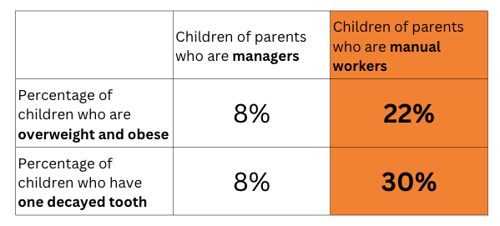
In the statistics I could find on French children, there are equity differences based on parent employment in rates of obesity and tooth decay.
As well as physical health, inequity is also prevalent in education. French priority education public schools (REP and REP+), which serve communities facing disadvantage, continue to trail other public schools in national assessments of six-year-olds. This gap (up to 30 percentage points) is especially prominent in problem solving and oral language.
Despite the fundamental commitment to egalité, realising a system that delivers proportionate universalism remains a challenge. This should galvanise us in the current policy environment to utilise the momentum and close the child equity gap.
How to do 'different' rather than 'more' for healthy and equitable child development
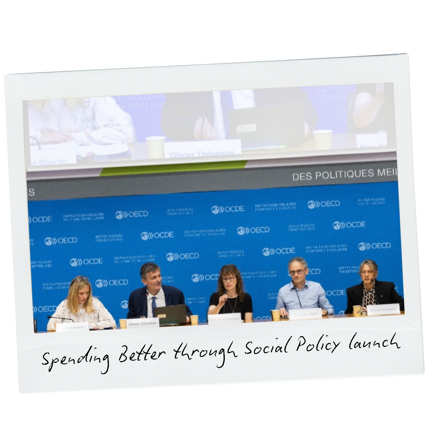
The Centre on Wellbeing, Inclusion, Sustainability and Equal Opportunity (WISE) launched its report Spending Better for Children through Social Policy in a hybrid event on 5 October. A recording of the event is now available to watch online.
I joined the roundtable session, which was an exciting opportunity to discuss the report and hear perspectives from policymakers from other countries.
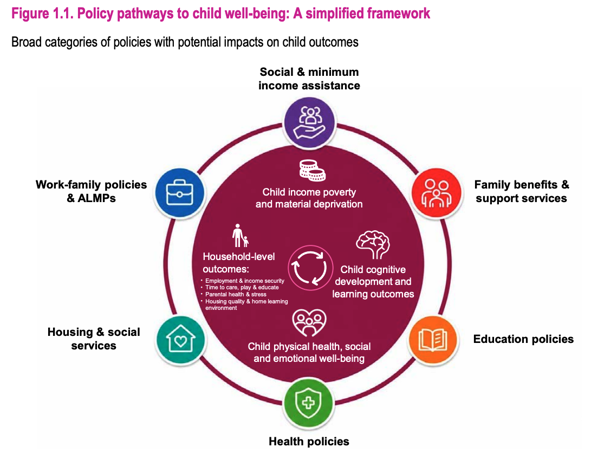
We all agreed that focusing on a limited but powerful set of social, health and educational policies that we know would make a difference to children’s outcomes was both compelling and attainable. It was quite the thrill to be on the podium at the OECD! Also, the Secretary General Mathias Cormann stayed for the entire presentation (yes, that’s the very same ex-Australian Minister for Finance)!
For those who are interested, there was some good discussion about the European Child Guarantee. It makes a commitment to:
- early childhood education and care
- education (including school-based activities)
- at least one healthy meal per school day
- healthcare
- healthy nutrition
- adequate housing.
Together, it makes up quite the commitment by EU countries, with the challenge of implementation remaining. Australia can now apply for EU Horizon grants - could we sign up to the Child Guarantee too?
Overall, the idea of the core stack of polices that can deliver outcomes for children really builds on what I think is the contemporary need to consider how we do different and not necessarily more. It aligns closely with our Changing Children's Chances and Restacking the Odds thinking about the importance of stacking - it is great to see this concept gaining momentum.
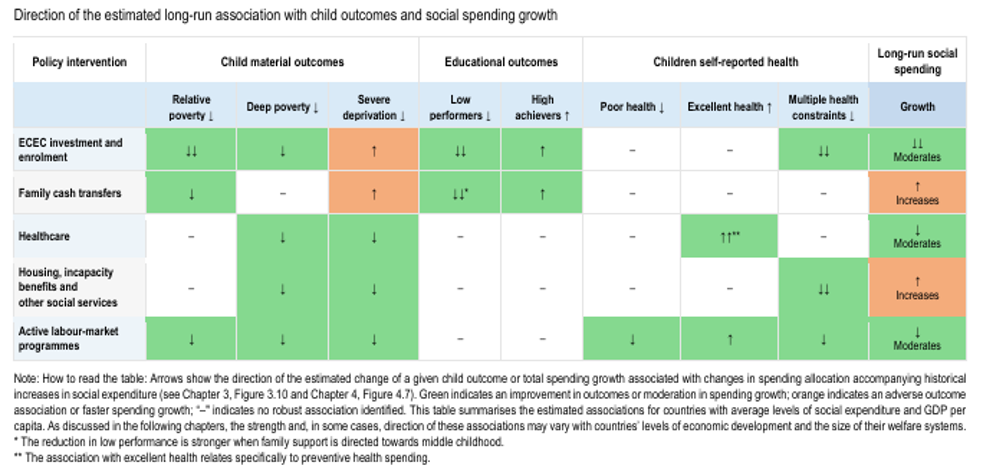
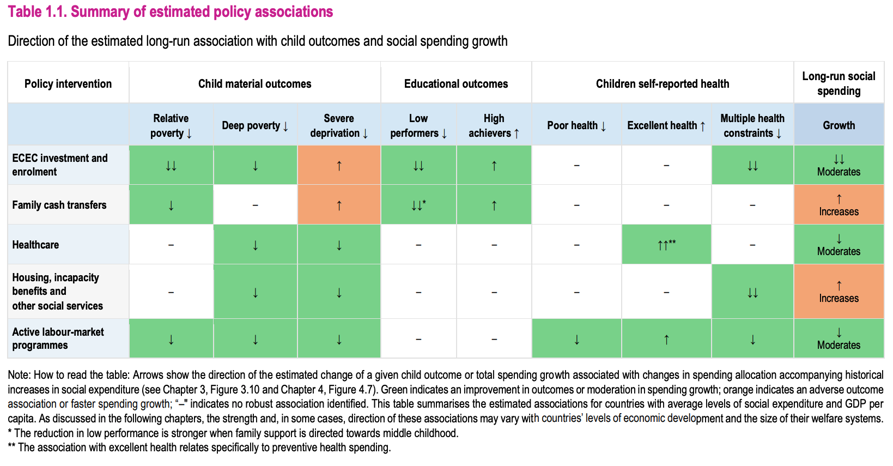
The star of the report is this table below which so neatly summarises its 250 pages! It’s worth noting the variable long term spending impact of different policies.
A critical junction for policy opportunities
Look out for this upcoming report from UNESCO, which identifies the right stack and sequence of policies needed in early childhood policy. All the analyses had to rely on administrative data, which made me think of the significance of Gen V in offering a testing platform for Victoria.
The report also introduces an interesting statistic: Children under 6 make up a third of the overall child population (0-18) but on average receive 15.7% of total child-related public spending.
I think this is incredible food for thought, and pushes us to think in a much more integrated way about how we can make a difference for Australia’s children. The current policy opportunity coincides with so much at stake.
The Icelandic experiment that has lots of lessons for Thriving Kids
You remember a terrific report from the OECD - Policy Responses to Rising Autism Diagnoses in Childhood - in my previous blog.
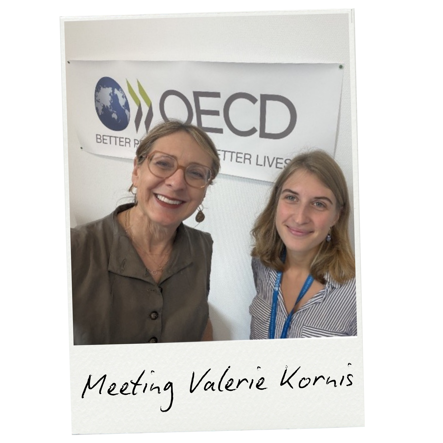 Let me introduce to one of the lead authors - I had the great pleasure of meeting Valerie Kornis, Disability Research Officer, Directorate for Employment, Labour and Social Affairs at the OECD.
She also let me know of some very interesting work in Iceland. The OECD has a case study of Iceland’s Prosperity Act which created a tiered system of integrated child services.
Children needing support get a local contact person or a municipal case manager, and the state and municipalities share the cost.
‘The primary level consists of basic services available to all children and parents, such as education, sports, and general health services. Early support is provided based on an initial assessment of the child's needs, with the coordinator working at this level. The secondary level offers individualised and structured support aimed at ensuring a child's well-being. If the assessment indicates the need for secondary level support, a Case Manager is assigned to the child or family. This Case Manager is responsible for providing access to services, designing a support plan, and overseeing its implementation. Tertiary level services involve specialised support to prevent any threat to the child's well-being. All services promoting children's well-being must prioritise the child's best interests.’
In other words, it was about navigators and the ‘glue’ to help families - not necessarily about more services. As far as I can tell, it focussed on humans with little dependence on digital mechanisms, which seems a missed opportunity.
The evidence behind it was a forward-looking economic assessment by external consultants (I was unable to get hold of this original report), built on international research on adverse childhood experiences. It assumed a 7% reduction in trauma and a 7% gain in resilience, which projected a return of roughly 9-11% and was used to argue the Act was cost-effective.
When I first read this, I was so excited! It was such an innovative idea to just help people connect and ensure they get what they need. But here’s the rub: Iceland’s National Audit Office (June 2026) found the ministry no longer had the underlying data, the assessment was unrealistic, no performance indicators or outcome evaluation had been set. Only about 5,200 children were registered against the 19,000 assumed. This meant that the costs per child were far higher, and child protection cases have risen rather than fallen. It is such a great lesson in how doing ‘different’ still needs evaluation and data for course correction along the way. That said, I met someone from the Icelandic government more recently, so more to say on this next time.
When resistance and art come together
 Egalité is the belief that citizens are equal before the law and therefore deserve an equal voice when challenging those in power.
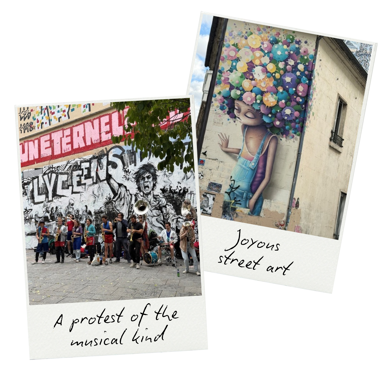
High school students have been protesting the poor state of their schools, the lack of teacher replacements and the generally underfunded system.
I had a lovely moment walking past a group of students outside their high school (lycee) listening to Neil Diamond’s Sweet Caroline and playing card games and chatting. No phones!
Then there was a joyous moment when a horn band assembled in front of some of the wonderful street art of Paris - also born out of protest. I took a video to capture the joy in the faces of everyone there despite (or maybe because of) protest.
Until next time
I’m finalising this blog on the way back from the ISSA 2026 conference in Lisbon. More details and pics next blog, but let’s just say Hubs were the definite idea of the moment.
A bientôt
Sharon