
‘From a seat at the table to knowing they belong there’
Rachel Parker
In September I had the privilege of chairing Stream B (Child voice, lived experience and shared decision making) at the 9th National Child Protection Forum in Meanjin/Brisbane, and of facilitating a post-conference workshop on embedding child voice in child protection systems. Both experiences strongly resonated with me.
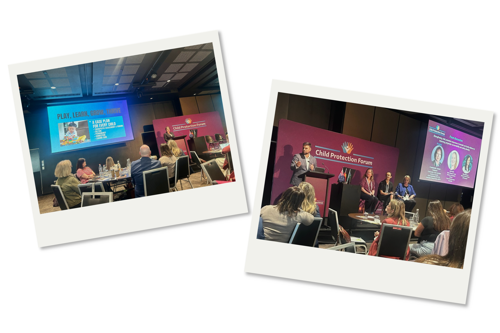
Emanuela Cozzoli and Vanessa Richardson from Child Protection Services at the Women’s and Children’s Hospital SA opened Stream B with a presentation on enacting child voice principles at the first point of contact with system. Their framework could help us expand the Lundy Model to include specific and detailed guidance for children affected by family violence, by incorporating safety, predictability, empowerment, compassion and attention to culture. Emanuela reminded us that including children’s voices is not about replacing the expertise of adults in the room; we include children to further empower and protect them.
Kate Fylan from The Salvation Army Australia reinforced the importance of language when discussing family violence, describing ‘men who choose to perpetrate violence’ – words that are agentic and imply that a different choice is available and that behaviour can change.
The youth-led session was the most powerful. Kaitlyn Asher and Victoria Harrison from Kids First Australia described how the Kids First Council shapes decisions and influences plans and directions, and in doing so challenges embedded power structures.
‘We must move from giving children and young people a seat at the table to knowing they belong there.’
- Kaitlyn Asher and Victoria Harrison
Viv Interrigi from the Centre for Excellence in Child and Family Welfare talked about ‘nothing without us’ as a fundamental principle when considering working ‘with’ people instead of ‘for’ people on issues of equity, diversity and inclusion.
Identifying, planning and measuring child voice projects
On the final day of the Forum, I led a three-hour workshop for 13 participants on using the MCRI Voice of the Child Toolkit to develop, plan, implement and evaluate child voice initiatives. We began with the Toolkit’s principles and the Lundy Model, and explored several examples including CCCH’s partnership with Minderoo and Polyglot Theatre. We then worked in groups to identify, plan and measure child voice projects.
Participants were incredibly engaged for the three hours and continued talking about their ambitions for child voice during the break. They were able to adapt the Toolkit principles for their own context. For example, if a child’s placement fell through, they considered what a child-first communication protocol would look like. How, when and in what form can children’s perspectives be prioritised instead of, in some cases, being the last to know?
During the conference, a speaker shared the experience of one child whose placement had ended early. The child asked whether it would be on the news. The child’s question makes a powerful case for Article 12 of the UN Convention on the Rights of the Child, that children have the right to express their views on matters that affect them. What could matter more than the place they call home? It’s their entire world, and through one simple question, this child helped us understand what losing it meant. We must hear and respond to children as though their voices are national news.