
Effective Early Identification
August 2026
Early identification of children with developmental delay/neurodevelopmental difference is described as a domain of support for Thriving Kids under the National Agreement. It combines validated screening tools, parental concerns and professional observation as part of routine, universal health and development checks over time.
The third issue of the Implementing Thriving Kids series describes how workforce and service uplift is required to ensure all children have access to timely, appropriate and accessible early identification as part of usual care.
Thriving Kids can reshape how universal services identify and respond to the needs of children and families to address inequity and better support early childhood development. This requires:
- a capable, connected and confident workforce
- strengthened universal services that apply a seek and respond model
- coordinated, integrated pathways that provide all children with the opportunity to thrive.
Related resources from the Centre
August 2026
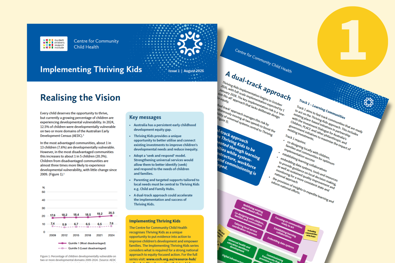
The first issue of the Implementing Thriving Kids series lays the foundation of the series with a focus on strengthening universal services, identifying the role of parenting and targeted supports, and presenting a dual-track approach to to accelerate implementation.
Parents’ Evaluation of Developmental Status-Revised® (PEDS-R®) is an evidence-based method for detecting and addressing developmental, behavioural and social-emotional/mental health concerns in children under eight years of age.

The ASQ-TRAK is a developmental screening tool for observing and monitoring the developmental progress of Aboriginal and Torres Strait Islander children. In 2023, the ASQ-TRAK2 was developed and now includes all 21 age intervals between two months and 5 1/2 years.

The STRONG kids, STRONG future team sits within the Department of Paediatrics at the University of Melbourne. They work in partnership with community on activities focused on research, development, training, and implementation of culturally appropriate development measures for Aboriginal and Torres Strait Islander children.
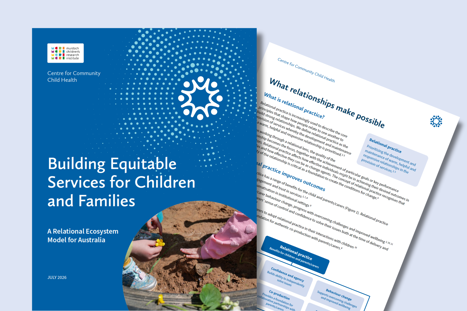
July 2026
Authors: Paul Prichard, Lauren Heery and Trina Hinkley
This paper presents an Australian, early years relational practice model that positions relationships within a broader practice-based ecosystem.
October 2013
Authors: Frank Oberklaid, Gillian Baird, Mitch Blair, Edward Melhuish, David Hall
Strategies which are likely to make a difference to children with developmental vulnerability and improve outcomes include family support, high-quality early education and care programmes in the preschool years, and early detection of emerging problems and risk factors. The evidence suggests that these services and programmes are best delivered within a framework of progressive universalism—a universal basket of services for all children and families, with additional support commensurate with additional needs.
September 2025
Authors: Anna Price, Elodie O'Connor, Sharon Goldfeld
Across Australian jurisdictions, child and family health services provide free, high quality, non-stigmatising, well child health care from birth to school entry. As universal primary health care, they have a critical role in health promotion, prevention, and early identification, and should be accessible regardless of geographic location or socio-economic status.